


Basement Waterproofing
As a homeowner, you might be wondering: How does Basement Waterproofing work and what are the exact methods of getting a wet basement to be permanently dry? In order to answer these questions, one must understand just what exactly a building foundation is.
The foundation can be defined as a crucial element of every structure that transfers the weight of the building to the ground. Whenever a structure is built, the soil gets excavated for the upcoming construction of the foundation. Typically, concrete footings are formed and after that, the foundation walls are installed onto these footings. Depending on each individual house and its age (and therefore also the way it was constructed), the material of the foundation walls can vary. Foundations of newer houses are generally made with cinderblock or are formed with poured concrete whereas older house foundations were often built with brick or natural fieldstone. Without proper foundation waterproofing, the above-mentioned materials have little to no water resistance capabilities.
Once the construction of a foundation has been finished, weeping tiles are placed at the bottom of the foundation beside the footings. Older weeping tiles were designed to be placed in separate segments and were made out of clay. These weeping tiles were generally connected into the main drain line and were to act as exterior water drainage for the building foundation. Over time, due to numerous factors (tree roots, soil clogging, excessive soil weight and pressure) these clay weeping tiles often become damaged, obsolete and no longer capable of functioning properly. As the soil around the building begins to collect water from rains or thawing snow, broken and non-functioning weeping tiles prevent the water in the soil to drain properly. This leads to volumes of water collecting in the soil and amassing at the building foundation, causing hydrostatic water pressure that will eventually penetrate the weakest spots in the foundation and will lead to moisture and water within the basement area.
In summary, it can be said that without proper waterproofing materials applied to the foundation walls and without proper drainage installed, a building foundation will sooner or later suffer from constant below ground water pressure. This will ultimately lead to visible signs within the basement area. Moisture, mold and dampness are all serious indicators of a foundation that is in need of waterproofing procedures. Generally, there are two different methods of preventing water from further getting into the basement area - exterior waterproofing and interior waterproofing.

Important Factors Homeowners should keep in mind when waterproofing their basement
In Ontario, various building materials are used for construction of foundation walls, with brick and fieldstone being common in older houses whereas cinderblock and poured concrete are usually used for construction of newer foundations. Each of these individual foundation types require a special approach when it comes to waterproofing material application. In order to neutralize moisture and preserve the structural integrity of foundation walls, certain buildings will necessitate additional means of repairs whilst other foundation types will need minimal preparations before waterproofing material application can commence. Being aware of these differences in foundations helps homeowners understand the scope of work that is required and prepare for the waterproofing project accordingly.
Access and space availability around the house are crucially important for exterior basement waterproofing procedures. In order to properly apply waterproofing materials onto the exterior side of the foundation walls, the soil adjacent to the house must be excavated down to the footings. This excavation process requires sufficient amount of space to temporarily store the dug out soil near the exposed foundation walls before backfilling it after waterproofing has been completed. Without adequate space, it becomes challenging or outright impossible to expose the foundation properly and carry out the waterproofing work effectively. Due to this, in certain cases, interior waterproofing becomes the only possible solution for a dry basement.
Numerous factors can affect the overall scope of work and, consequently, the cost of a project. These factors include the depth of the basement, the presence of underground installations close to the foundation walls, the building’s age, and the current condition of the foundation. Each of these elements can affect both the complexity and the amount of work required, which directly impacts the final price for completing the project.
Our team is always prepared to offer a professional on-site estimate that includes a thorough evaluation of your project. We prioritize convenience and accuracy, ensuring you have a clear understanding of the scope and cost before any work begins.


Excessive depth waterproofing requires shorings for safety. (and ladders too!)
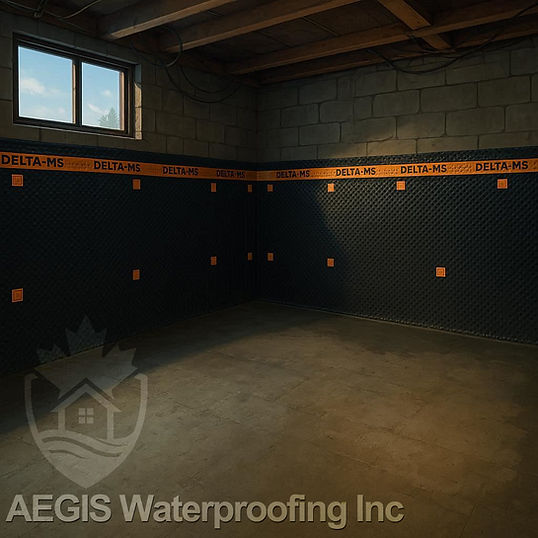
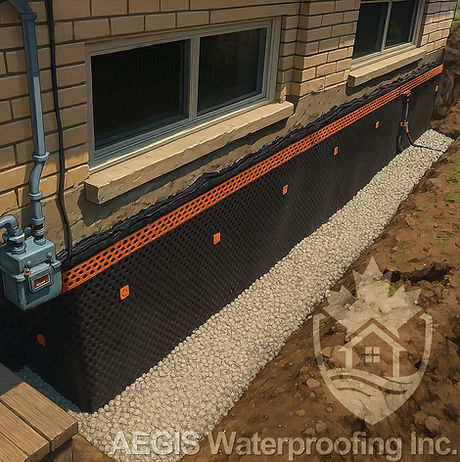
DELTA-MS Foundation Membrane installation.
Excavators, shovels and jumping jacks.
Examples of exterior & interior waterproofing projects.


Products used by
AEGIS Waterproofing Inc.
Elastomeric, liquid-applied, emulsified asphalt membranes designed for below ground waterproofing applications. Aqua-Bloc 720-38, Aqua-Bloc 770-06,
"Liquid Rubber" Waterproofing Foundation Sealant, Blueskin WP 200 rubberized asphalt compound membrane.
Delta-MS Foundation Membrane designed for below ground water drainage.
Big ‘O’ 4 Inch, High Density Polyethylene (HDPE) corrugated, perforated weeping tile system designed for collection and drainage of below ground water.

Sump pumps including emergency battery backup automatic sump pump models.
Rapid setting, high-strength water resistant hydraulic cement applications designed for foundation repair prior to waterproofing material installation.
List of our services:
At AEGIS Waterproofing Inc., we specialize in a wide range of waterproofing projects and foundation repair services. Our team is experienced in installing all types of basement waterproofing materials, designed to meet your specific needs. Whether you require interior or exterior waterproofing solutions, drainage systems, or sump pump/backwater valve installation, we handle it all with quality and care. Our comprehensive service ensures your basement stays dry and your foundation remains guarded from water. Our list of services includes but is not limited to:
Residential and commercial exterior waterproofing projects.
Residential and commercial interior waterproofing projects.
Building foundation inspections, excavations and weeping tile installation.
We focus on installation services for sump pumps and water jet pumps, ensuring efficient and reliable operation.
Installation, repairs and maintenance of catch basins
Landscape drain work (French drains, various landscape drain installation projects.)
Excavation works that include heavy machinery for both residential and commercial projects.
Drain installation, drain replacement and drain repair projects. This includes both sanitary and storm drain lines that are in need of maintenance.
